Rss Feed Tweeter button Facebook button

Archive for Allgemein

L’importanza del Tedesco

É da pochi giorni stato messo in circolazione nelle scuole italiane un dossier informativo (Ministero dell’Istruzione, dell’Università e della Ricerca – USR per la Lombardia) sull’importanza del tedesco come lingua straniera. In modo particolare per noi Italiani che abbiamo un rapporto culturale ed economico notevole con la Germania.

L’ho trovato molto interessante e ve ne riporto una breve parte:

il tedesco è la lingua madre più parlata in Europa, (da oltre 100 milioni di persone), è una delle più diffuse sul web e una delle lingue ufficiali più utilizzate nell’Unione Europea.
La struttura profonda del tedesco aiuta, inoltre, la riflessione formale, lessicale e morfosintattica e rafforza le abilità logiche, trasversali a tutte le discipline.
La conoscenza del tedesco non solo apre ad una nuova cultura e permette di comprendere meglio la musica, la letteratura, la filosofia e la scienza, ma offre anche maggiori opportunità di studio e di ricerca, essendo i paesi di lingua tedesca tra i più richiesti in Europa per stage e tirocini universitari, soprattutto in ambito scientifico e tecnologico.
La Germania, in particolare, è il paese che ha affrontato meglio la crisi finanziaria ed economica di questi ultimi anni, grazie ad un sistema industriale basato sulle esportazioni non solo di merci, ma soprattutto di tecnologia e know-how. Questo le ha permesso recentemente di aprire il proprio mercato del lavoro a personale qualificato proveniente dall’estero, rendendo disponibili entro il 2025 ben 800.000 posti di lavoro.

Apprendere questa lingua rappresenta una scelta strategica e un investimento per il proprio futuro lavorativo, soprattutto in un momento di alta disoccupazione giovanile come quello attuale.


Trovate il dossier completo qui

filippo

VN:F [1.9.13_1145]
Rating: 0.0/5 (0 votes cast)
VN:F [1.9.13_1145]
Rating: 0 (from 0 votes)

More functions than a Swiss Army Knife: WERDEN!

Das Verb “werden” hat auf Deutsch viele Benutzungen .

1. Werden als Hauptverb.
Wenn allein benutzt es bedeutet “to become”.

Er wurde Arzt. He became a doctor.
Es wird kalt. It’s getting cold.
Mein Bruder wird heute 31. My brother’s turning 31 today.

2. Werden als Hilfsverb.
Es ist benutzt, um die Futur formieren. Es bedeut “will do”.

Ich werde nach Hause gehen. I will go home.
Es wird morgen schneien. It will snow tomorrow.

3. Werden als Hilfsverb für die Passiv.
es bedeutet “is done/was done”. Wenn für die Passiv benutzt, werden wird in Indikativform formiert, und das Hauptverb wird in Partizip formiert(gemacht).

Mein Auto wird repariert. My car is being repaired.
Die Suppe wurde gekocht. The soup was being cooked.

4. Endlich, werden als Hilfsverb für Conjunktiv.
Es bedeutet “would do”. Es wird in Conjunktiv II formiert (würde), und das Hauptverb wird in Infinitiv formiert.

Ich würde nach Hause gehen. I would go home.
Er würde ein Haus kaufen. He would buy a house.

filippo

VN:F [1.9.13_1145]
Rating: 0.0/5 (0 votes cast)
VN:F [1.9.13_1145]
Rating: 0 (from 0 votes)

How hard is that?

A very common question when you get interested in languages is: “What is the hardest language to learn?”. The answer is a complicated one. This is because the answer varies from person to person and also depends on what your native language is.

Your Mother Tongue

There are no languages simple to learn, but the ones more closely related to your native language are certainly going to be easier to learn than ones that are not.

A completely different writing system (for example the one with ideograms) can also be a tough challenge, though that does not necessarily make a language more difficult. Grammar and sentence structure can often play a larger role in difficulty.

Most Difficult Language?

The statistics and rankings included in the infographic below are provided by the the Foreign Service Institute (FSI) of the US Department of State and are intended for native English speakers.

Photo credit and Infographic source: zidbits.com

VN:F [1.9.13_1145]
Rating: 0.0/5 (0 votes cast)
VN:F [1.9.13_1145]
Rating: 0 (from 0 votes)

Interrail!

Vergesst ihr die typische Reise, die ein Flug wird genommen, um ein Platz zu besuchen.

Denkt ihr anders. Denkt ihr an eine Reise, bei der der Transport, die ganze Bewegung ein integraler Bestandteil der Reise ist… Habt ihr Reiselust jetzt? Ich denke so!

Interrail ist ein Gemeinsamprojekt von die meisten europäische Bahnen. Es ist möglich, um sehr viele Züge zu nehem von Land bis zu andere Land, und alle mit ein einzig Reisekarte!

Es gibt 2 Möglichkeiten: ein Globalpass für die ganze Europa-netz, und ein Coutrypass, für eine einzig Land Ihrer Wahl.

Im Sommer 2010 haben wir ein Interrail trip gemacht. Unsere Abreise war Wageningen, Niederlande. Erstmal haben wir ein direkt-zug nach Warschau (via Köln, Hannover und Berlin) genommen. Dann wir haben nach Krakow gefahrt (und das Schönes der polische Mädchen anerkennen!). Danach haben wir Wien, Bratislava, Kosice, Budapest und Ljubljana besucht. Mehr als 4000 km mit dem Zug!

VN:F [1.9.13_1145]
Rating: 5.0/5 (1 vote cast)
VN:F [1.9.13_1145]
Rating: 0 (from 0 votes)

Time to say salute!

Unfortunately my time in DeustchAkademie it is over and my time in Munich is almost over as well. I need to go back home and finish my studies, but I can’t do that before leaving a message here to every single person that was part of my history here in Munich.

First I would like to thank my flat mattes: Papi and Fili. Without you guys, my stayed in Munich would not be the same. I’ve learnt a lot from you, since small thinks like bad words in other languages, cooking tortillas and not eating spaghetti with a knife to how to be a better person, understand the others, to be patient…I am really happy because I had the opportunity to realize a dream close to wonderful people and much more than that, friends.

Then, I need to thank everybody that worked with me at Kraft Foods, my supervisors, my colleagues, my friends, Rosa from the canteen, the “Hallo Malzeit” guy from the reception, the cleaning ladies…well, everybody that contributed somehow to make every day delicious.

The last one but not less important, I would like to thank DeutschAkademie, especially Janina and Veronica, my teachers. Thanks girls for the patience and for the knowledge shared.  Know that there is still a lot of things to do and this was only the beginning but before join D.A I thought that learning German was impossible, and now I know that if I dedicate myself I can do it.

Ah, and of course, thanks Florian for the opportunity you gave me to write for the blog. It was a pleasure.

Vielen Dank und bis Später,

Gabi

VN:F [1.9.13_1145]
Rating: 0.0/5 (0 votes cast)
VN:F [1.9.13_1145]
Rating: 0 (from 0 votes)

Deutschakademie: how does it work?

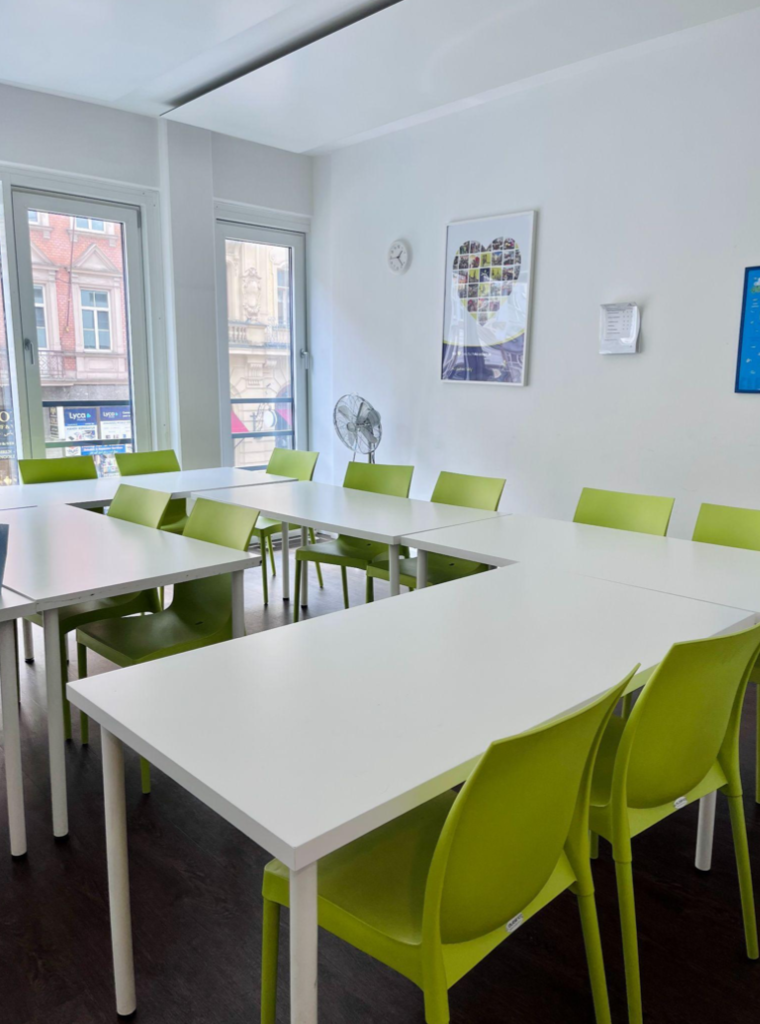
Groups of 5 to maximum 10 participants. That means more opportunity to speak and to have more attention from the teacher. Kleingruppen - maximal 9 Teilnehmer in Ihrem Deutschkurs  in München

Location: in the centre


The German course always take place right in the centre of Munich, close to the Stachus. Very easy to reach and within walk distance from the historical centre.


Deutschkurse mitten im Zentrum von München

Qualified German teachers


The teacher are professional, and speak ONLY GERMAN! That’s a huge advantage since you start to pick up a lot of phrases and a whole style of speaking!


Qualifizierte Deutschlehrer an der Deutschakademie München

Practical course times


The German course at the DeutschAkademie in Munich has practical course times: learn German from 9-12 a.m., 12 a.m. – 3 p.m., 3 p.m. to 6 p.m. or 6p.m. to 9 p.m.!

VN:F [1.9.13_1145]
Rating: 5.0/5 (1 vote cast)
VN:F [1.9.13_1145]
Rating: +1 (from 1 vote)

305 steps

The St. Peter’s Church in Marienplatz (Rindermarkt 1) is the oldest Roman Catholic church in Munich and it is considered the best place to go if you want to have the most incredible view of whole Munich –  and when the weather is good you can also see the alpes.

For students the ticket is only 1 Euro and for Adults 1,50. When people arrive there the first question that they do is:

- Entschuldigung, Wo ist der Aufzug?

- Tut me sehr leide aber wir haven keine Aufzug.

I am sorry guys but there is no lift and it is necessary to climb 305 stairs to go up there, but it really worth it. The view it is something else! You can walk around the top of the church and have a view of the for directions of the city: Sendlinger Tor, Isartor, Karlsplatz and Odeonsplatz.

And one of the best sensations is to be inside the church and listen to the big bells. You can feel the vibration!

Gabi

VN:F [1.9.13_1145]
Rating: 0.0/5 (0 votes cast)
VN:F [1.9.13_1145]
Rating: 0 (from 0 votes)

A tip for Italians in Munich

Ciao a tutti,

Sono Filippo, vengo da Piacenza e attualmente sono a Monaco per un tirocinio di 6 mesi. Ho deciso di iniziare a studiare tedesco sin da quando sono arrivato a Settembre. La vera ragione è che mi appassionano molto lingue e culture diverse, specialmente quando mi trovo in un ambiente nuovo, in un nuovo paese. Ho deciso, dopo aver valutato diverse scuole di tedesco a Monaco, di studiare presso la DeutscheAkademie (Karlsplatz).

Dal prossimo 6 febbraio inizierò il 5 corso: B1.2. Sono rimasto colpito dai progressi raggiunti fino ad oggi; sono passato da non sapere niente più di “Kartoffeln” “Achtung!” e “Raus!”… a riuscire a comunicare con i madrelingua. Riesco a conversare su diversi argomenti usando frasi anche complicate. Putroppo il mio vero problema è il vocabolario… molte parole non hanno in comune nulla con la nostra lingua e vanno semplicemente assorbite.

A tutti gli Italiani in Germania: Alles Gute mit ihrem Deutschlernen!

filippo

VN:F [1.9.13_1145]
Rating: 0.0/5 (0 votes cast)
VN:F [1.9.13_1145]
Rating: 0 (from 0 votes)

Winter Wonderland: Neuschwanstein!

Do you wanna see the Disney Castle? I mean, not the fake one you can find at Disneyland… Yes, that’s real and you can visit it.

King Ludwig II almost sent his kingdom to bankruptcy, by perseverating in a colossal project for a dream romantic castle. Ironically, the same castle that at the time of his construction almost drained the pockets of the Bavarians, today is by far the largest moneymaker in Germany and one of the most visited place in Europe (1.5 million people yearly). In summer the castle receives up to 6000 visitors per day!

So if you want to see something astonishing, in a winter wonderland setup with less tourists around, definitely go to Neuschwanstein in winter! Only precaution: cover yourself heavily. Today it was a sunny day with -22 °C !!!

filippo

VN:F [1.9.13_1145]
Rating: 0.0/5 (0 votes cast)
VN:F [1.9.13_1145]
Rating: 0 (from 0 votes)

B1.1. das Passiv!

Deutschsprache benutzt das Passiv so ähnlich . Der Hauptunterschied ist: in Deustsch das Passiv wird mit “werden” gebildet.

Wie in Englisch, das direkt Objekt im Akkusativ wird das Subjekt von der Passivsatz.

Sie sieht ihn. -       Er wird gesehen

Wenn du ein Handlungsträger identifizieren willst, dann gib es: von + dat

Er wird gesehen von ihm.


Verbszeiten

Präsens (present): Du wirst gesehen.
Präteritum (simple past): Du wurdest gesehen.
Perfekt (present perfect): Du bist gesehen worden.
Futur (future): Du wirst gesehen werden.
Präsens mit Modalverb (present with modal): Du kannst gesehen werden.
Präteritum mit Modalverb (past with modal verb): Du konntest gesehen werden.

Sieht das sehr schwer aus? ^_^

Filippo

VN:F [1.9.13_1145]
Rating: 0.0/5 (0 votes cast)
VN:F [1.9.13_1145]
Rating: 0 (from 0 votes)